How do you use this Arabic calligraphy generator?
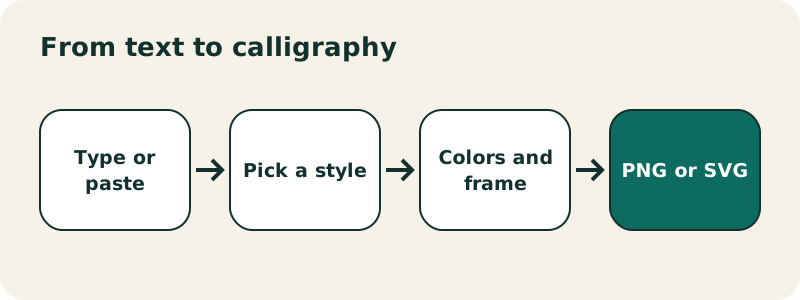
The Arabic calligraphy generator above turns Arabic text into an image. Type in the top box and the preview redraws at every letter. The text can run over several lines (press Enter) and up to 200 characters: enough for a name, a greeting or a short phrase.
No Arabic keyboard?
Tick Phonetic input and type in Latin letters, with the same rules as our English to Arabic keyboard: sh gives ش, 3 gives ع, 7 gives ح. The conversion is letter by letter, so type slam, not salam, to get سلام. If you paste Latin text, the generator spots it and offers a Convert to Arabic button. You can also type on the Arabic keyboard and paste here.
The generator draws Arabic letters; it does not translate. An English word typed as is stays in Latin letters in the image.
Which calligraphy styles does the generator offer?
An online generator does not replace a calligrapher's pen: it sets letters with a font inspired by a style. So we always name both the style and the font, and we never claim a font imitates a style it does not.
| Style in the tool | Font | What it draws on |
|---|---|---|
| Naskh | Amiri | The Naskh of books printed in Cairo in the early 20th century |
| Naskh | Scheherazade New | A traditional Naskh with very complete harakat |
| Display Naskh | Mirza | A text Naskh with ligatures and a stronger stroke |
| Naskh with Thuluth touches | Katibeh | A display Naskh given some Thuluth features by its designers |
| Kufic | Reem Kufi | Early Quranic Kufic on a Fatimid grid |
| Manuscript Kufic | Qahiri | Manuscript Kufic, regularized in the 20th century |
| Ruqaa | Aref Ruqaa | Ruqʿa, the everyday handwriting |
| Poster Ruqaa | Rakkas | The Ruqʿa of Egyptian film posters from the 1950s and 1960s |
| Nastaliq | Gulzar | Nastaliq in its Urdu form |
| Poster lettering | Lalezar | The lettering of Iranian film posters from the 1960s and 1970s |
| Hand-drawn decorative | Marhey | Playful, high-contrast hand lettering |
Wikipedia confirms the lineage of the first one: "the Amiri typeface is inspired by the Naskh script used at the Amiri Press in Cairo". Three major styles are missing, and we would rather say so: we found no free font that faithfully reproduces Thuluth, Diwani or Maghribi. For a real piece in those styles, you need a calligrapher.
What are the main styles of Arabic calligraphy?
“Arabic calligraphy is the artistic practice of handwriting and calligraphy based on the Arabic alphabet.”
Kufic
Named after the city of Kufa in Iraq, Kufic is one of the oldest forms of Arabic calligraphy: angular letters on a very straight baseline, seen in early Qurans on parchment, on coins and on buildings. It has decorative offshoots, including square (geometric) Kufic, built on a grid.
Naskh
Rounded and very readable, Naskh is the style of books, schools and most computer fonts. It carries harakat well, which makes it the safe choice for a longer text, a quote or a name everyone must be able to read.
Thuluth
A monumental script with tall shafts and interlaced letters, used on mosque walls, title pages and inscriptions in wood or stone.
Ruqʿa
The everyday handwriting of much of the Arab world: short letters, few flourishes, quick strokes. It gives names a natural, handwritten feel.
Diwani and Nastaliq
Diwani grew in the Ottoman chancery: dense, ornate and hard to read, used today for invitations and diplomas. Nastaliq comes from the Persian world and slopes down word after word; it is mostly used for Persian and Urdu and does not use the kashida, so the generator turns stretching off for it.
How do you write your name in Arabic calligraphy?
First, spell it correctly in Arabic letters. That is a transcription, not a translation: you write the sounds. Arabic has no letter for p or v, and short vowels are not written, so one name can have several defensible spellings.
| Name | In Arabic | Note |
|---|---|---|
| Maryam / Miriam | مريم | One common spelling |
| Yusuf / Joseph | يوسف | The long u is written و |
| Sarah | سارة | Ends in ta marbuta ة |
| Adam | آدم | Starts with alif madda آ |
| Noor / Nour | نور | Means "light" |
| Yasmin / Jasmine | ياسمين | Means "jasmine" |
| Jack | جاك | English j is written ج |
For a name of Arabic origin, use its original spelling: Mohammed, Muhammad and Mohamed are all محمد. For an English name, transcribe the pronunciation, then check with someone who reads Arabic. Our Arabic alphabet page shows which letter matches which sound.
What do the kashida and harakat settings do?
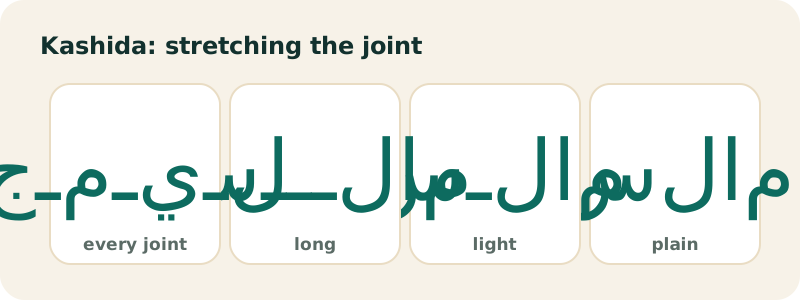
The kashida, or tatweel (ـ), lengthens the joining stroke between two letters. Calligraphers use it to balance a line or highlight a word. The generator offers Light (one per word, at the last possible joint), Long (three tatweel at the same place) and Every joint, for a deliberate decorative effect. It never stretches after a letter that does not join the next one (ا د ذ ر ز و), nor between lam and alif, to keep the لا ligature.
Harakat are the short vowel marks. The generator shows those you typed; untick "Show harakat" to hide them without deleting them. To add some, use the Arabic keyboard with harakat and paste the text here.
بِسْمِ اللَّهِ الرَّحْمَٰنِ الرَّحِيمِ
Which file should you download: PNG or SVG?
- Download PNG saves the image with its background.
- PNG, transparent background saves the same image without a background, to place on a photo, a card or a T-shirt mockup.
- Download SVG saves a vector file: the text stays text and the font is embedded, so it scales without blur in a browser, Inkscape or a cutting machine's software. Some older programs ignore embedded fonts; use the PNG for those.
Size goes from 40 to 240 pixels per line, and the exported image is drawn at twice the preview size, up to 4,096 pixels on the longer side. Your last text and settings are kept in your browser's local storage for next time; nothing is uploaded.
What should you check before printing, engraving or a tattoo?
For print, choose a large size before exporting; for wall art, a T-shirt or vinyl cutting, prefer the SVG. A tattoo cannot be corrected, so show the image to one or two people who read Arabic fluently. They will check what is most often wrong:
- Spelling: a near letter (ح or خ, س or ص) changes the word.
- Direction: Arabic reads right to left. A mirrored image is unreadable.
- Joining: letters inside a word must connect. Separate letters side by side betray software without Arabic support.
- Small marks: dots and harakat that are too small blur on skin over time.
Can you use the images freely?
Yes. The 11 fonts are released under the SIL Open Font License 1.1, a free license, and hosted on this site with their license files. The OFL covers the fonts themselves; the images you make with them belong to you, for personal or commercial use, with no credit required. Two limits remain yours to respect: the text must be yours or free (a modern poem or a brand slogan can be protected), and only what you generate here is free, not a calligrapher's artwork found online.
Frequently asked questions
Is the Arabic calligraphy generator free?
Yes. No sign-up, no watermark, and the images are yours.
Can I write my name in Arabic calligraphy?
Yes. Spell it in Arabic letters, or tick Phonetic input and type it in Latin letters without short vowels, then pick a style.
Does the generator translate English into Arabic?
No. It draws Arabic letters. Translate first, or type Arabic words in Latin letters with phonetic input.
Which style is easiest to read?
Naskh (Amiri or Scheherazade New). Kufic and Nastaliq are more decorative and harder to read when small.
Can I get a transparent background?
Yes: tick Transparent background, or use the PNG, transparent background button.
What is the best format for a Cricut or a print shop?
SVG, because it is a vector file that stays sharp at any size.
Is there a Thuluth or Diwani font?
Not in the generator: we found no free font that faithfully reproduces them, and we do not label an ordinary font with those names.
Why is stretching disabled for Nastaliq?
The Nastaliq font has no tatweel, and Nastaliq tradition does not use the kashida.
Is my text uploaded anywhere?
No. The image is drawn in your browser; the text and files stay on your device.
How long can the text be?
Up to 200 characters, over several lines if you press Enter.
Related pages
Arabic keyboard — Free online Arabic keyboard: type Arabic with your QWERTY keyboard or by tapping the keys, then copy the text anywhere.
See also:
Sources
- Arabic calligraphy — Wikipedia
- Kufic — Wikipedia
- Naskh (script) — Wikipedia
- Kashida — Wikipedia
- Google Fonts repository (ofl/ folder) — Google Fonts
- SIL Open Font License 1.1 — SIL