What is the Arabic alphabet?
The Arabic alphabet is the script used to write Arabic, and, with extra letters, Persian, Urdu, Kurdish, Pashto and other languages. Wikipedia defines it precisely:
“The Arabic alphabet, or the Arabic abjad, is the Arabic script as specifically codified for writing the Arabic language.”
"Abjad" means that the letters write consonants and long vowels; short vowels are left out, or added as small marks called harakat. Four facts explain almost everything else:
- It is written and read from right to left; numbers, however, run left to right.
- There are no capital letters.
- Letters join inside a word, even in print, so most have up to four shapes.
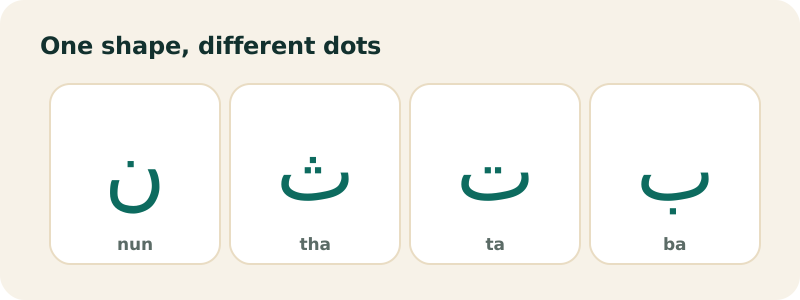
- Many letters share a base shape and differ only by their dots: ب ت ث are one stroke with one, two or three dots.
What are the 28 letters of the Arabic alphabet?
In dictionary order (called hijā'ī), with a simple transliteration, the closest English sound, the QWERTY key that types the letter on a standard Arabic keyboard, and one example word:
| # | Letter | Name | Sound | QWERTY key | Example |
|---|---|---|---|---|---|
| 1 | ا | alif | long a, as in father; also carries hamza | H | أسد (asad, lion) |
| 2 | ب | ba | b, as in bed | F | بيت (bayt, house) |
| 3 | ت | ta | t, as in top | J | تفاح (tuffāḥ, apples) |
| 4 | ث | tha | th, as in think | E | ثعلب (ṯaʿlab, fox) |
| 5 | ج | jim | j, as in jam (g in Egypt) | [ | جمل (ǧamal, camel) |
| 6 | ح | ḥa | a strong, breathy h from the throat | P | حليب (ḥalīb, milk) |
| 7 | خ | kha | ch, as in Scottish loch | O | خبز (ḫubz, bread) |
| 8 | د | dal | d, as in dog | ] | دار (dār, house, home) |
| 9 | ذ | dhal | th, as in this | ` | ذهب (ḏahab, gold) |
| 10 | ر | ra | a tapped or rolled r | V | رجل (raǧul, man) |
| 11 | ز | zay | z, as in zoo | . | زيت (zayt, oil) |
| 12 | س | sin | s, as in sun | S | سمك (samak, fish) |
| 13 | ش | shin | sh, as in ship | A | شاي (šāy, tea) |
| 14 | ص | ṣad | a heavy s, tongue raised at the back | W | صباح (ṣabāḥ, morning) |
| 15 | ض | ḍad | a heavy d | Q | ضوء (ḍawʾ, light) |
| 16 | ط | ṭa | a heavy t | ' | طائرة (ṭāʾira, airplane) |
| 17 | ظ | ẓa | a heavy th (as in this) or z | / | ظل (ẓill, shade) |
| 18 | ع | ʿayn | a squeezed sound from the throat, no English equivalent | U | عين (ʿayn, eye) |
| 19 | غ | ghayn | a gargled r, like French r | Y | غزال (ġazāl, gazelle) |
| 20 | ف | fa | f, as in fan | T | فيل (fīl, elephant) |
| 21 | ق | qaf | a k pronounced deep in the throat | R | قمر (qamar, moon) |
| 22 | ك | kaf | k, as in kite | ; | كتاب (kitāb, book) |
| 23 | ل | lam | l, as in lamp | G | ليل (layl, night) |
| 24 | م | mim | m, as in moon | L | ماء (māʾ, water) |
| 25 | ن | nun | n, as in net | K | نور (nūr, light) |
| 26 | ه | ha | h, as in hat | I | هلال (hilāl, crescent moon) |
| 27 | و | waw | w, as in wet, or long u | , | ورد (ward, roses) |
| 28 | ي | ya | y, as in yes, or long i | D | يد (yad, hand) |
The sound descriptions are approximations for English speakers. Several letters (ح ص ض ط ظ ع غ ق) have no real equivalent in English; listening to a native speaker is the only way to learn them well.
Why does a letter change shape?
Because Arabic is cursive. A letter connects to its neighbours, and its shape adapts: isolated (on its own), initial (joined only to the next letter), medial (joined on both sides) and final (joined only to the previous letter). When you type, you always press the same key; the font picks the right shape.
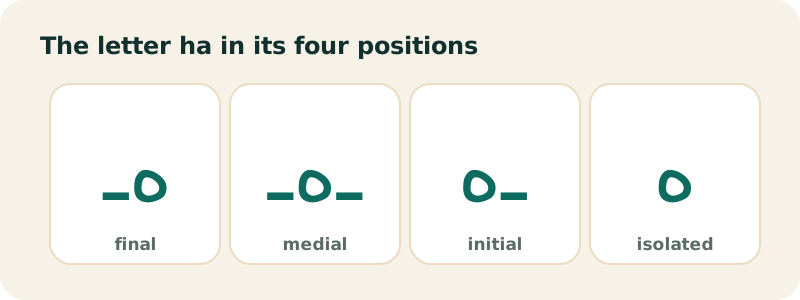
Most letters keep a recognizable core. A few change a lot: ه (ha) and ع (ayn) look quite different at the start and in the middle of a word, and ك (kaf) loses its small inner stroke when it joins.
What are the four forms of each letter?
The table reads right to left in each Arabic cell. A dash (tatweel) shows where the letter connects.
| Letter | Isolated | Initial | Medial | Final |
|---|---|---|---|---|
| alif | ا | ا | ـا | ـا |
| ba | ب | بـ | ـبـ | ـب |
| ta | ت | تـ | ـتـ | ـت |
| tha | ث | ثـ | ـثـ | ـث |
| jim | ج | جـ | ـجـ | ـج |
| ḥa | ح | حـ | ـحـ | ـح |
| kha | خ | خـ | ـخـ | ـخ |
| dal | د | د | ـد | ـد |
| dhal | ذ | ذ | ـذ | ـذ |
| ra | ر | ر | ـر | ـر |
| zay | ز | ز | ـز | ـز |
| sin | س | سـ | ـسـ | ـس |
| shin | ش | شـ | ـشـ | ـش |
| ṣad | ص | صـ | ـصـ | ـص |
| ḍad | ض | ضـ | ـضـ | ـض |
| ṭa | ط | طـ | ـطـ | ـط |
| ẓa | ظ | ظـ | ـظـ | ـظ |
| ʿayn | ع | عـ | ـعـ | ـع |
| ghayn | غ | غـ | ـغـ | ـغ |
| fa | ف | فـ | ـفـ | ـف |
| qaf | ق | قـ | ـقـ | ـق |
| kaf | ك | كـ | ـكـ | ـك |
| lam | ل | لـ | ـلـ | ـل |
| mim | م | مـ | ـمـ | ـم |
| nun | ن | نـ | ـنـ | ـن |
| ha | ه | هـ | ـهـ | ـه |
| waw | و | و | ـو | ـو |
| ya | ي | يـ | ـيـ | ـي |
Type a word in the keyboard above and watch the shapes change as you add letters: ب, then بي, then بيت (house).
Which letters do not join the next letter?
Six letters connect only to the letter before them, never to the one after: ا د ذ ر ز و. After one of them, the next letter starts a new group, which is why a word like وردة (warda, "rose") looks like separate pieces. Their initial form is the same as the isolated one, and their medial form the same as the final one.
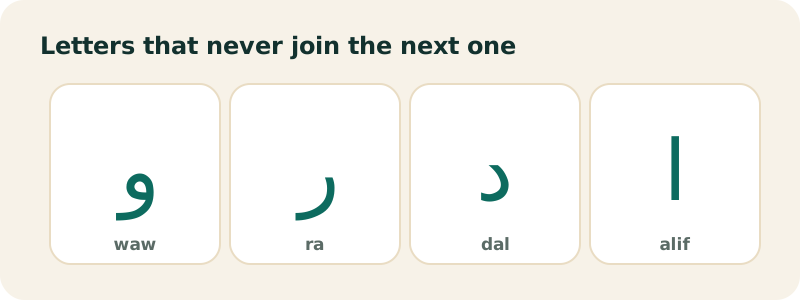
When you read, these gaps are not spaces between words; real spaces are wider. Telling the two apart is one of the first reading skills learners build.
What about hamza, ta marbuta and alif maqsura?
These three are not counted among the 28 letters in most lists, but you meet them in nearly every text.
Hamza ء
A glottal stop, the catch in uh-oh. It can stand alone (ء, key X) or sit on a "seat": أ (Shift+H), إ (Shift+Y), ؤ (C) or ئ (Z). The seat depends on the surrounding vowels; the harakat page lists every form.
Ta marbuta ة
A ha with two dots, used only at the end of a word, mostly feminine nouns: مدرسة (madrasa, school). It is pronounced a, or at when the word is followed by another in a phrase. Key M.
Alif maqsura ى
A ya without dots, at the end of a word, pronounced as a long a: على (ʿalā, on). Key N. In Egyptian print the dotless form is also used for final ya, which can confuse learners.
Lam-alif لا
When lam is followed by alif, they merge into a ligature, لا (lā, no). The keyboard has a key for it (B), but typing G then H gives exactly the same result.
What are sun and moon letters?
The Arabic word for "the", ال (al-), is always written the same way, but its l is not always pronounced. Before 14 "sun letters" the l assimilates and the next consonant doubles: الشمس is said ash-shams (the sun), not al-shams. Before the other 14, the "moon letters", the l stays: القمر is al-qamar (the moon).
| Group | Letters |
|---|---|
| Sun letters (l is silent) | ت ث د ذ ر ز س ش ص ض ط ظ ل ن |
| Moon letters (l is pronounced) | ا ب ج ح خ ع غ ف ق ك م ه و ي |
A shortcut: sun letters are pronounced with the tip of the tongue near the teeth, like t, d, s, n and l themselves.
Which letters are easy to confuse?
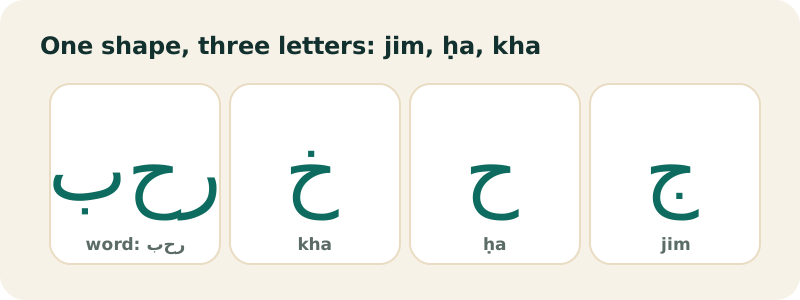
- ح خ ج: same shape; no dot, a dot above, a dot below.
- س ش and ص ض: three teeth vs. a loop; dots make the second of each pair.
- د ذ and ر ز: small letters that differ only by one dot.
- ط ظ: same loop with a stroke; the dot gives ẓa.
- ف ق: one dot or two; qaf also dips lower at the end of a word.
- ه ة and ي ى: the ending letters above.
For sounds, the common traps for English speakers are ه vs ح (soft h vs strong h), ك vs ق, and each plain letter vs its heavy twin: س/ص, د/ض, ت/ط, ذ/ظ.
In which order are the letters listed?
The order above, which groups letters by shape, is the one used in dictionaries and schools today. An older order, abjadī (أبجد هوز حطي…), follows the ancient Semitic sequence and gives each letter a number value. Wikipedia notes:
“Modern dictionaries and reference books use the hijāʾī alphabetical order instead of the Abjadi alphabetical order, in which letters are arranged mainly by similarity of shape.”
Where are the letters on an Arabic keyboard?
Not in alphabetical order: like QWERTY, the Arabic layout places frequent letters under strong fingers. The keyboard on this page shows each key's QWERTY label, so you can find any letter without memorizing anything. The home row holds ش س ي ب ل ا ت ن م ك ط on A to '.
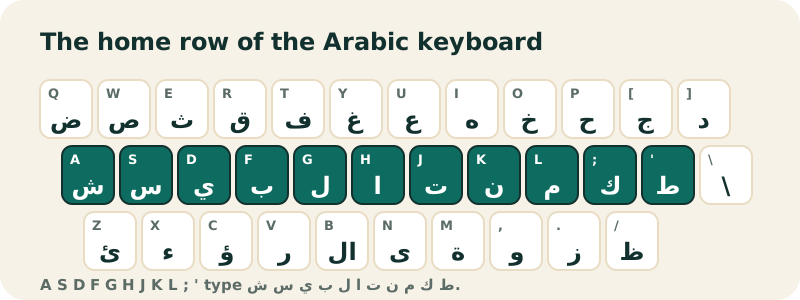
To learn the layout by heart, try the Arabic typing test lessons. To type Arabic with English letters instead, use the English to Arabic keyboard.
How do you start learning the Arabic alphabet?
- Learn the letters in shape families (ب ت ث, ج ح خ, د ذ, ر ز…) rather than one by one.
- Say each letter aloud while you type it in the keyboard above.
- Read short, vowelled words: harakat tell you exactly how to pronounce them.
- Copy simple words by typing them: بيت, باب, قلم, شمس.
- Move to unvowelled text once the letters feel automatic.
Writing by hand still matters for memory, but typing gives you instant, correct shapes to compare with. The Arabic keyboard keeps your draft between visits, so you can build a word list over several days.
How are Arabic letters encoded on computers?
Each letter has one Unicode code point in the Arabic block (U+0600 to U+06FF), whatever its shape: ب is always U+0628. The four shapes are produced by the font at display time. That is why Arabic you type here pastes correctly anywhere, and why searching for a word finds it whatever its position. The W3C explains how browsers handle the right-to-left direction in its article on bidirectional text.
Frequently asked questions
How many letters are in the Arabic alphabet?
28. Hamza is sometimes counted as a 29th; ta marbuta and alif maqsura are variants used at the end of words.
Is Arabic written right to left?
Yes, letters and words run right to left. Numbers are written left to right, most significant digit first.
Does Arabic have capital letters?
No. Arabic has a single case. Letters change shape only according to their position in the word.
What are the vowels in Arabic?
Three long vowels written with letters (ا و ي) and three short vowels written as optional marks: fatha, damma and kasra.
Which Arabic letters do not connect?
ا د ذ ر ز و connect to the letter before them but never to the letter after them.
What is the hardest Arabic letter to pronounce?
For English speakers, usually ع (ayn) and ح (ḥa), both produced in the throat, followed by the heavy consonants ص ض ط ظ and ق.
How do I type the Arabic alphabet on my keyboard?
Use the keyboard on this page: each key shows its QWERTY label. Or add the Arabic layout to your computer or phone.
How long does it take to learn the Arabic alphabet?
It varies a lot from person to person. Learning the shapes in families and practising a little every day is more effective than long, rare sessions.
Is the Arabic alphabet the same as the Persian or Urdu alphabet?
They share the same base. Persian and Urdu add letters such as پ چ ژ گ, and Urdu more besides.
What is the first letter of the Arabic alphabet?
Alif, ا. The last one in dictionary order is ya, ي.
Related pages
Arabic keyboard — Free online Arabic keyboard: type Arabic with your QWERTY keyboard or by tapping the keys, then copy the text anywhere.
See also:
Sources
- Arabic alphabet — Wikipedia
- Arabic diacritics — Wikipedia
- Arabic keyboard — Wikipedia
- Unicode Bidirectional Algorithm basics — W3C